Medical records, digitised
Every parcha.
Perfectly understood.
India's health records are handwritten, photographed and filed away unreadable. MyParcha turns any of them into structured, verified data — in seconds, at a fraction of what it costs to read them by hand.
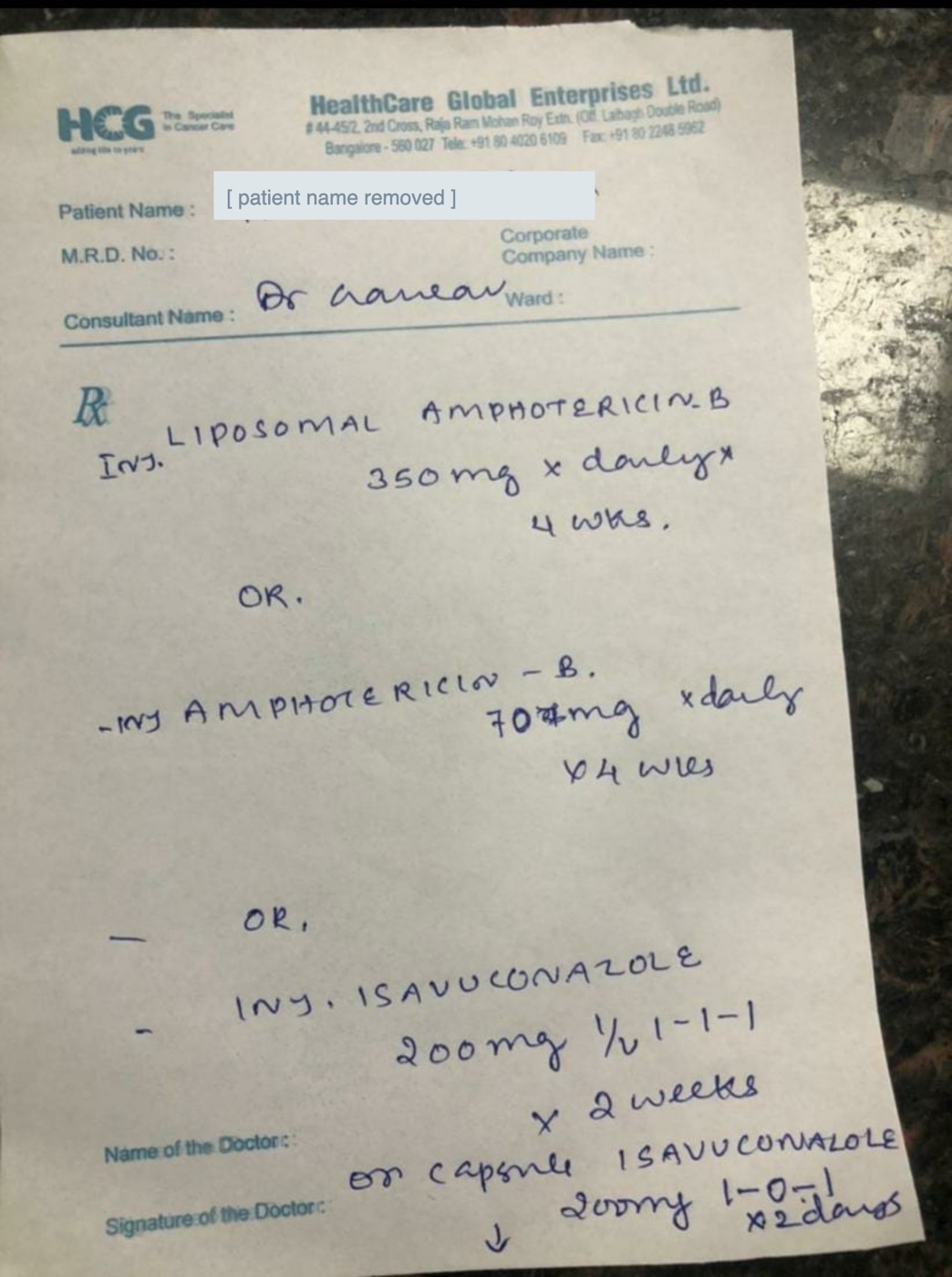 What you have
A real hospital prescription. The patient's name is masked; nothing else is altered.

| # | Medicine | Dose | How often |
|---|---|---|---|
| 1 | Inj. LIPOSOMAL AMPHOTERICIN B contains Liposomal Amphotericin B | 350 mg | daily for 28 days |
| 2 | Inj AMPHOTERICIN - B. contains Amphotericin B | 70 mg | daily for 28 days |
| 3 | INJ. ISAVUCONAZOLE contains Isavuconazole | 200 mg | morning, afternoon and night for 14 days |
| 4 | capsule ISAVUCONAZOLE contains Isavuconazole | 200mg | morning and night for 2 days |
The digital parcha we issue — printable, shareable, verifiable.
Demonstration only; MyParcha is not affiliated with the clinic shown.
Try it yourself
Can't read your own prescription?
Photograph it and MyParcha will tell you the medicines, how often to take them and for how long — in plain words. Free, no account, and your photo isn't stored.
The hidden cost
Somebody is reading all of it by hand.
At an insurer or a TPA, every claim means a person squinting at a discharge summary, a bill and a stack of prescriptions. It costs ₹30–50 a document, it is slow, and it is where errors quietly enter the system.
Why people trust it
It tells you when it isn't sure.
In the prescription above — four antifungals in all-capital handwriting, on a form nobody designed for a computer — MyParcha read every medicine correctly and matched all four to their generic composition. On a Mumbai clinic's parcha it resolved Lanol-ER to Paracetamol and Dompan to Domperidone, straight from the handwriting.
And on a genuinely illegible one, it does the opposite of pretending: it read the medicine, reported just 28% confidence, and sent every field for a human to confirm. See that one →
That is the whole design. A wrong dose is not a software bug — it is a patient-safety event. So nothing uncertain ever slips silently into your data.
Handwriting was hard to read · not found in the Indian medicine database
The medicine database
Indian medicine names, verified — not guessed.
Dolo becomes Paracetamol. Azithral becomes Azithromycin. Zerodol SP becomes Aceclofenac with Paracetamol. Every match is chosen from a real database of Indian brands — the system is not able to invent a medicine that doesn't exist.
What it reads
Four kinds of paper. One clean output.
Prescriptions
Handwritten or printed. Brand names resolved to their generic composition.
Lab reports
Every value with its unit and reference range, flagged high or low.
Discharge summaries
Admission and discharge dates, procedures, and the medicines advised on leaving.
Hospital bills
Line items and totals — with the arithmetic checked against itself.
However it arrives
Photograph it. Upload a thousand. Or just say it out loud.
Photograph
A doctor holds up a phone in the OPD. One tap, and the record exists.
Bulk upload
Send the archive. Hundreds of documents process in the background, with per-document status.
Dictate
Speak the prescription in Hindi or English. MyParcha writes it up — Indian brand names and all.
Who it's for
Built for whoever is drowning in paper.
Insurers & TPAs
Claims data your adjudication system can act on.
Diagnostic labs
Reports as data, not flat PDFs.
Hospitals
Digitise the archive, issue digital parchas.
Health-tech teams
One API in, FHIR back.
Talk to us
Send us your worst document.
The messiest parcha, the longest discharge summary, the bill nobody can reconcile. We'll run it through and show you exactly what comes back.
- ✓No commitment — A walkthrough on your own documents, not a canned demo.
- ✓A reply within one working day — From someone who can answer technical questions.
- ✓Your document is not kept — We read it for the walkthrough and delete it afterwards.
Prefer email? [email protected]